Though I spent much of my time at athenahealth as a high-level individual contributor, I became known across the org as someone you could turn to if you needed to figure something out. Whether it was a craft issue, career progression, or interpersonal dynamics, designers came to me with their burning questions, and I’d help them work through it. Several members of the UX org also engaged me for formal mentoring arrangements, including:
- Principal Designers looking to build their influence within their domains
- A Content Designer trying to strike a balance between strategic and ad-hoc projects in a highly visible, but unclear role
- A UX Zone Lead trying to bring research rigor to a team of mostly visual/UI designers without sacrificing speed or quality
And of course, there were myriad designers, zone leads, and even Product folks who came by periodically for advice on career management, how to use a given tool or method, or just needed an ear for a while. My “work auntie” persona was so well developed that one of our Principal Designers even recruited me for a conference panel and corresponding Medium article on Design’s Role in the Age of AI.
Design Debt Strategy
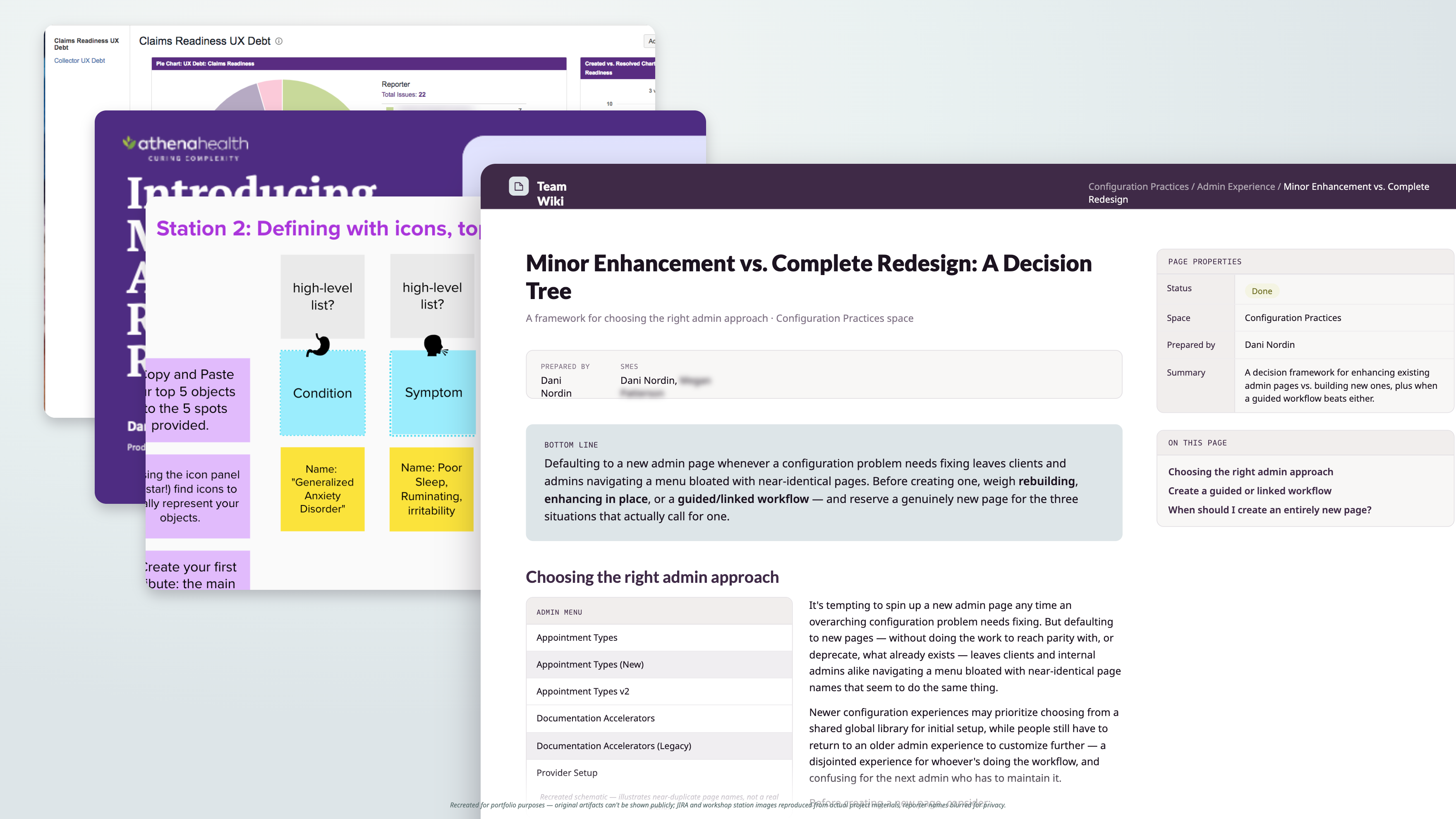
In my first year at athenahealth, I was asked to collaborate with others in the design org to develop a process for cataloguing and prioritizing UX Debt - those little annoyances that remain in the UI long after the team has moved on to other priorities. A team of us worked together to align on a shared definition of UX debt, an approach to capturing it, and materials to socialize the approach throughout the UX org. I also wrote an article for athenahealth Design’s Medium publication describing the work.
The work we did evolved to roll out across the full R&D Organization as an initiative called “Minor Enhancements,” or “MEs.” As part of the initiative, each zone was accountable for resolving a specific amount of MEs per release. To support this, I created custom JIRA tags and dashboards that would allow each zone to track progress against their backlog of enhancements.
Object-Oriented UX (OOUX) Training
One of the things people don’t say enough about EHRs is that first and foremost, they’re content management systems. Note templates, macros, clinical documents, even the visit notes themselves are all system objects with unique attributes. Figuring out how these attributes map together is one of the core challenges designers in this space have to deal with.
In 2021, I became certified in OOUX, which helps designers map out the information and data elements within a system object (read: Content Type) in a way that facilitates conversation among the team. I used this method in a number of projects at athena, to map out things like the Behavioral Health treatment plan, the Surgical Case for ASC, and several projects related to interoperability.
In 2022, I worked with Sophia Prater to bring a truncated OOUX training workshop to athena’s UX org. Over half the team worked together over two separate sessions to get the basics of the ORCA process. When it was done, I led an independent training/certification session at athenahealth with a half dozen motivated designers.
The training led to designers across the UX org using OOUX in their own projects, which proved invaluable in domains like Interoperability, Work Management, and even major new features such as Event Summaries.
Best practice standards and documentation
Throughout the years, I played a pivotal role in establishing and documenting best practices across a variety of topic areas for athena’s R&D org. In addition to facilitating working groups associated with the topic, I took the lead on primary research and Confluence documentation. I also took part in socializing the standards across the organization, alongside other initiative leads as appropriate.
- UX for AI-Driven experiences: along with a team of UXers from across the org, I helped us catalogue what we’d been learning collectively into an established set of patterns and practices for designing and validating these experiences.
- Best practices for Marvin and the Marvin MCP: I worked with a cross-divisional team of researchers to test, procure, and train the UX org on Marvin, an AI-powered research repository. I also coordinated the transition from Dovetail to Marvin within Clinicals, and documented best practices for organizing projects.
- User-Centered Performance metrics: working with a Product Manager and a couple of seasoned architects, we crafted comprehensive guidance and case studies for measuring system performance across several types of experiences, based loosely on Google’s HEART Framework.
- Configuration Experiences: Based on research I’d done on best practice configuration for Clinicals, I worked with a cross-organizational team of designers to put together comprehensive guidelines for designing these experiences — including baseline Figma files.
- I also helped lead a Hackathon team to build a “configuration page toolkit” that would accelerate development. Our project won both Most Business Value and People’s Choice awards that year.
Internal presentations
Frequently, as I learned new techniques or tools, I gave presentations to designers across Clinicals or in the UX Org’s All Hands. Topics included things like AI for research, prompt writing, storytelling, and influence. I would also regularly share case studies or research insights from my work at both the biweekly Clinicals UX Shareout and the regular UX Organization all hands.